

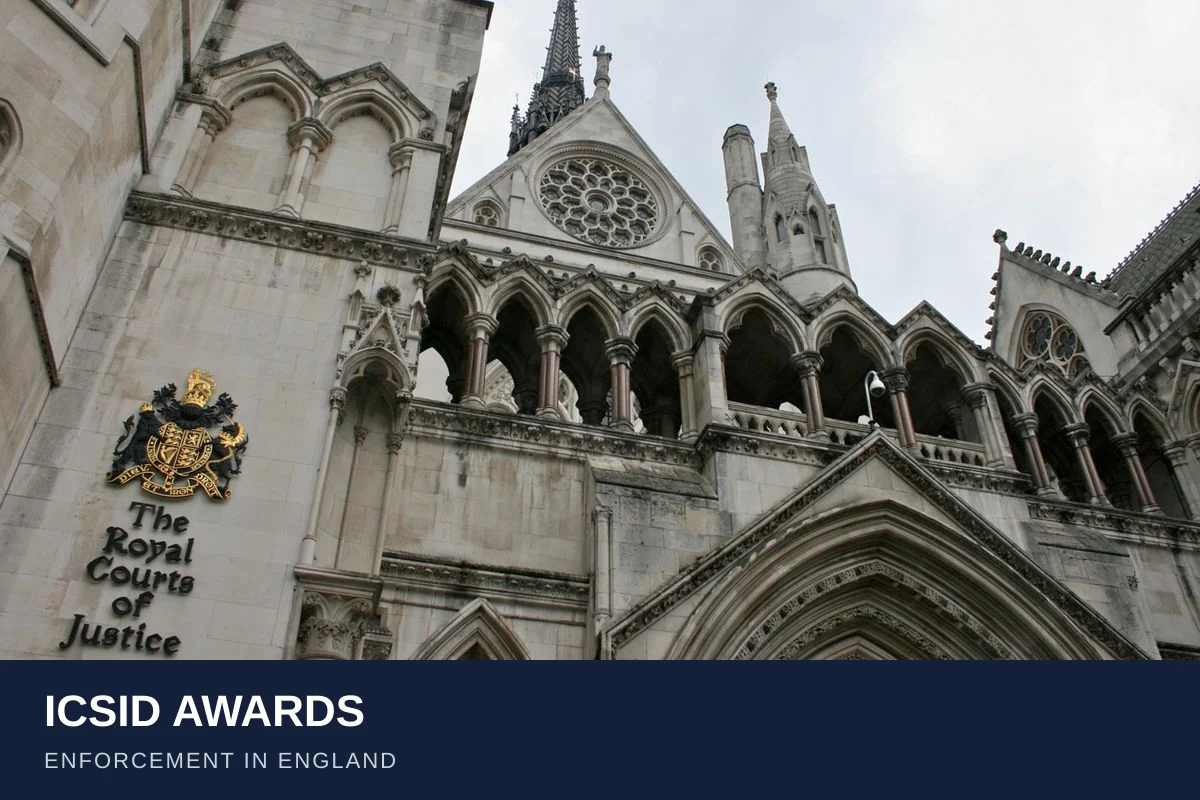
The English Court of Appeal has rejected Blasket Renewable Investments LLC’s attempt to replace the original investors in proceedings over a €29.3 million ICSID award against Spain. The unanimous decision, handed down on 2 November 2026, is a significant obstacle to an award buyer seeking recognition and enforcement in its own name in England and Wales.
The case is Operafund Eco-Invest Sicav Plc & Ors v The Kingdom of Spain [2026] EWCA Civ 1392. It concerns who can invoke the ICSID enforcement machinery, rather than a fresh examination of Spain’s liability for the underlying investment dispute.
How the award reached a buyer
The underlying dispute arose from changes to Spain’s renewable-energy incentive regime. Operafund Eco-Invest and Schwab Holding obtained an award in 2019. It was registered in England in 2021; Spain subsequently challenged registration.
In January 2024, the investors entered into a Swiss-law assignment agreement with Blasket. Blasket then sought substitution in the English proceedings. The Commercial Court refused, and the Court of Appeal has upheld that result. Foxton LJ gave the leading judgment, with Lewison and Males LJJ agreeing.
The commercial problem: cash today, recovery later
An award is a legal determination, but it is not necessarily money in the creditor’s bank account. Identifying assets, defending challenges and pursuing recovery can consume time and capital. Selling an economic interest can allow a successful investor to exchange uncertain future receipts for a more immediate return.
For a purchaser, the calculation runs in the other direction: the price paid must leave room for legal costs, delay and the risk of collecting less than expected. This is why the identity of the person entitled to bring proceedings is commercially consequential. A promising asset search is of limited use if the buyer cannot use the relevant enforcement route.
Three questions the transaction cannot collapse into one
The court’s reasoning distinguishes the parties’ sale contract, the international-law entitlement embodied in the ICSID award, and the domestic machinery used to pursue it. An agreement between seller and buyer does not automatically settle all three.
Its principal conclusions were that treaty rights cannot be assigned without the obligor state’s consent under customary international law; Article 54(2) does not give a voluntary assignee in Blasket’s position the original award party’s standing; and English registration does not manufacture a new substantive right that escapes those restrictions. The absence of an express treaty prohibition was insufficient.
That distinction matters beyond the wording of an assignment clause. Choosing a national law for the purchase agreement cannot by itself enlarge the obligations that an international treaty imposes on a state.
Why registration is not a cure
Section 2 of the 1966 Act supplies the English mechanism for registering ICSID awards. It gives a registered award the force and effect specified by the legislation for execution. That domestic machinery must be understood in the context of the Convention; it is not an opportunity to replace the award’s underlying legal character with a freely transferable ordinary judgment debt.
There is also a further practical distinction. Recognition and enforcement do not guarantee successful measures against state assets. ICSID’s own guidance explains that the Convention preserves applicable immunity from execution. A creditor therefore needs to examine both its entitlement to invoke the process and the availability of assets against which recovery is legally possible.
Important limits to the headline
This is not a ruling that every arbitration award is untradeable. Commercial awards enforced under the New York Convention sit within a different framework. Nor did the court decide every form of succession or transfer: insolvency, death and corporate succession raise questions different from a voluntary transfer by a creditor that continues to exist.
The judgment also records that other national courts have taken different approaches. That disagreement is a reason to analyse each proposed recovery jurisdiction carefully, not to assume that either the English result or a favourable foreign decision automatically travels worldwide.
The English court did not accept Spain’s separate argument that Article 15 of the Energy Charter Treaty would itself exclude an otherwise-existing right of assignment. Keeping that point separate avoids attributing the whole result to an implied ECT prohibition.
What investors and purchasers should examine
- What is being acquired? Distinguish the award, its proceeds, contractual control rights and the right to bring proceedings.
- Who remains the claimant? Test the proposed structure against the rules of each intended enforcement forum.
- What continuing co-operation is needed? Consider the seller’s existence, authority, obligations and exposure to costs.
- What can actually be recovered? Assess immunity, asset ownership, litigation cost and delay separately from the award’s face value.
These are transaction-planning implications, not a judicial endorsement of a particular workaround. The judgment notes that the original investors’ ability to pursue recovery, and contractual arrangements concerning proceeds, are distinct from Blasket’s unsuccessful substitution request.
What happens next
Essex Court Chambers, whose counsel acted for Spain, reported on 3 November that Blasket had sought permission to appeal to the Supreme Court. That is an application, not a grant of permission or an overturned judgment. As at publication, the Court of Appeal decision is the reported English appellate position.
Published 5 November 2026. Judgment date: 2 November 2026. Reporting is based on the public judgment; practical observations are Arbitration BITS editorial analysis.
Go to the source.
- Court of Appeal: Operafund Eco-Invest Sicav Plc & Ors v Spain [2026] EWCA Civ 1392, 2 November 2026
- Essex Court Chambers: case report, 3 November 2026; counsel from the chambers acted for Spain
- ICSID: recognition and enforcement under the ICSID Convention
- Arbitration (International Investment Disputes) Act 1966, section 2
- Photograph: Mike Peel, The Royal Courts of Justice; CC BY-SA 4.0
- Image adaptation licence: Creative Commons Attribution-ShareAlike 4.0
