
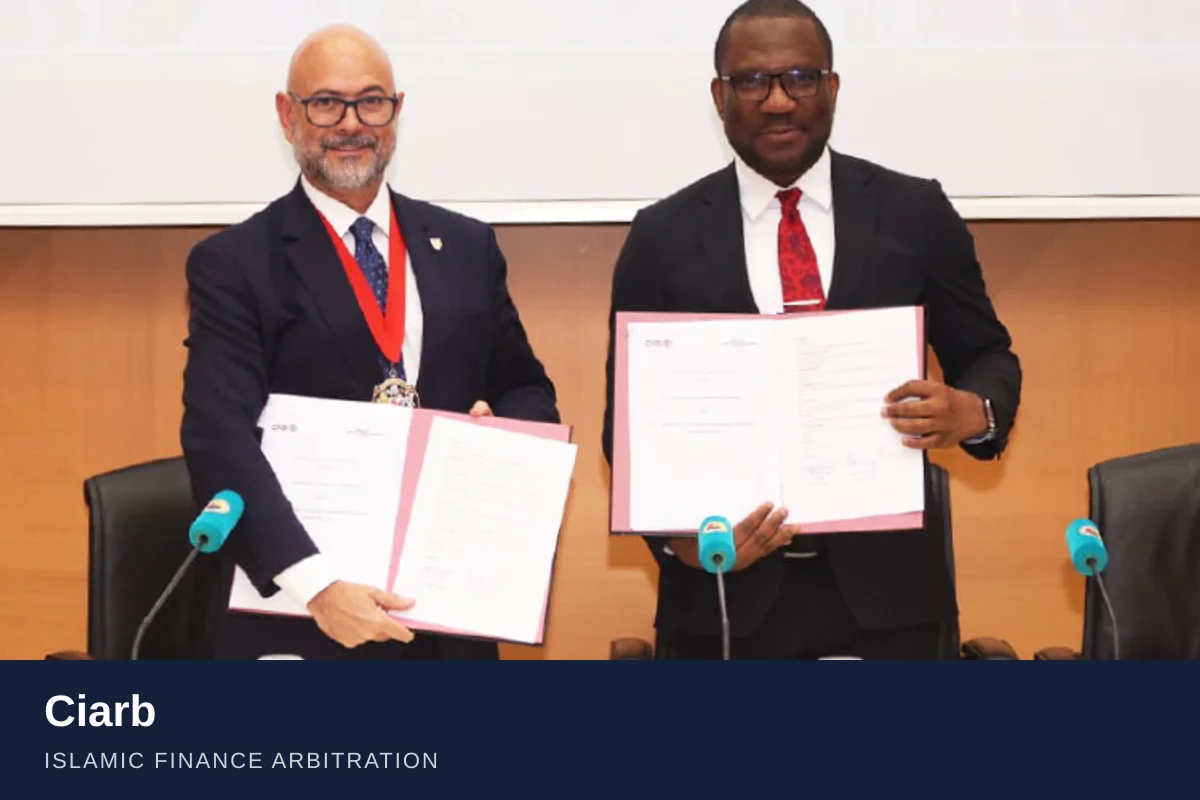
The Chartered Institute of Arbitrators and the Organisation of Islamic Cooperation Arbitration Centre have agreed to develop a Specialist Certificate Programme in Islamic Finance Arbitration. Ciarb announced the memorandum of understanding on 30 October 2026 during OIC Arbitration Week in Istanbul.
The partnership aims to combine specialist education, professional standards and an accreditation pathway. Its immediate significance is the commitment to develop that framework. The announcement does not provide a settled curriculum, entry criteria, accreditation arrangements or an implementation timetable; those details are to follow.
What has been agreed
The institutions describe a pathway intended to improve the pool of practitioners able to handle Islamic finance disputes. Potential inclusion on the OIC-AC arbitrator roster would remain subject to the Centre’s eligibility and governance requirements. The stated ambition extends to work at other institutions and in ad hoc proceedings.
Those qualifications matter. Completing a future programme should not be presented as an automatic arbitral appointment, guaranteed roster admission or a new regulatory licence. Practitioners considering it will need to examine the eventual assessment and accreditation arrangements when they are published.
Why the subject needs more than a general label
For a dispute-resolution lawyer, describing a transaction as “Islamic finance” is the start of an enquiry. The actual documents, chosen law, commercial structure and questions in dispute need to be identified before the legal issues can be assessed.
Take a hypothetical cross-border financing dispute. One party alleges a payment default; the other says the transaction did not operate in the way the documents contemplated. A tribunal may need to examine the contractual steps, the evidence of performance and the legal effect of any Shariah-related provisions. It should not assume that a broad product description answers those questions.
The same discipline applies to expert evidence. A tribunal should distinguish an expert’s explanation of a structure or principle from the legal decision it must make under the applicable framework. Specialism is valuable when it improves that enquiry, rather than replacing careful analysis with general statements about an entire legal tradition.
Several legal questions can coexist
As a practical framework, parties can separate four questions:
- The contract: What rights and obligations were actually agreed, and which law governs them?
- Any incorporated standards: What precise language refers to Shariah principles or external standards, and what legal effect does that language have?
- The arbitration: What is the scope of consent, the seat and the procedural framework?
- The remedy and enforcement: What relief is sought, and where might recognition or recovery be needed?
This is an editorial checklist, not the announced syllabus. It illustrates why a useful specialist programme needs to connect transactional understanding with dispute-resolution technique. It also explains why choosing an arbitrator, choosing a governing law and choosing a seat are separate decisions.
Specialist training does not replace local enforcement analysis
The New York Convention provides an international framework for recognising and enforcing qualifying foreign arbitral awards. Article V includes grounds relating to the arbitration agreement, procedural fairness, the tribunal’s mandate, arbitrability and public policy. Its operation must be assessed in the relevant jurisdiction.
The existence of a specialist certificate cannot guarantee that an award will satisfy those requirements. Nor should different national approaches to Shariah-related matters be flattened into a single rule. Parties need to consider the actual legal system and the particular contract and remedy.
For readers starting with that distinction, our legal-traditions BITS Primer explains how contract law, arbitral procedure and enforcement law can interact within one dispute.
What practitioners should look for next
Before deciding whether to apply, prospective participants should look for the final learning outcomes, teaching format, assessment method, entry requirements, fees and dates. It will also be useful to see how the programme distinguishes educational achievement from any separate professional or roster status.
For institutions and users, the longer-term question is whether the pathway makes relevant expertise easier to identify and assess. That cannot be measured from the MoU alone. The published framework and its implementation will provide the next basis for evaluation.
The agreement is therefore a concrete capacity-building announcement, with important operational details still open. Reporting that boundary accurately gives readers something more useful than treating a planned programme as an already available qualification.
Published 5 November 2026. Institutional announcement: 30 October 2026. Programme facts are drawn from Ciarb’s official statement; explanatory examples and the checklist are Arbitration BITS editorial analysis.